⚠️ Important Notice About Translation
This content is translated using Google Translate and can be accessed in approximately 30+ languages worldwide, in order to make the content more accessible to non-English speakers.
However, due to the limitations of machine translation, many sentences may contain unnatural phrasing, incorrect terminology, or misinterpretation of the original meaning—especially in technical or philosophical contexts.
Please be aware that this translation is not professionally edited and may not fully reflect the precise intent or nuance of the original document.
For the most accurate understanding, we strongly recommend referring to the original English version of this paper, which represents the author's intended wording and conceptual clarity.
On Structural Form: Atemporal Coherence of
Hodge Classes in Algebraic Varieties
Keunsoo Yoon  Independent Research Group (Seoul, Republic of Korea)
austiny@gatech.edu, austiny@snu.ac.kr
Independent Research Group (Seoul, Republic of Korea)
austiny@gatech.edu, austiny@snu.ac.kr
Mar 30, 2026
Abstract
The Hodge Conjecture asks whether certain topological cohomology classes admit algebraic
realization. Despite substantial progress, its continued resistance suggests that the central difficulty
may lie not only in technical complexity, but also in the assumption that realizability must be
established through sequential construction. This motivates a different perspective: realizability
may be governed less by symbolic derivation than by structural admissibility.
In this paper, we reinterpret the Hodge Conjecture within the framework of the Changbal Jump
Machine (CJM) as a problem of structural admissibility in the atemporal complexity class O(J).
Under this view, configurations are mapped into a Hodge-closure representation, and admissibility
is evaluated through global coherence, stability, and topological closure. Transformation therefore
precedes computation: the Hodge structure is treated not primarily as an object to be sequentially
constructed, but as a structural lens through which realizability can be discriminated.
On this basis, we introduce CJM–Hodge as a specialized admissibility filter within the broader
CJM architecture. In this formulation, realizable states correspond to structurally stable attractors
rather than to outcomes of symbolic derivation. No formal proof of the Hodge Conjecture is
claimed. Rather, the aim is to propose a conceptual and structural reformulation in which algebraic
realizability is interpreted as a question of closure, coherence, and stability. This perspective is
intended to clarify how mathematical structure may be recast in terms of structural permission,
while preserving the conjecture itself as an open problem.
Keywords: Atemporal Computation; Changbal Jump Machine (CJM); O(J); Structural Equilibrium; Hodge
conjecture; Trinity Resonance; P vs NP; NP Problem; Time Crystal; allthingsareP; =
The Master Manifesto. We propose a shift in addressing the Millennium Prize Problems
from exclusively formal, time-bound proof toward structural and physically discriminable
experimentation, reinterpreting mathematical conjectures not as statements requiring
asymptotic derivation but as questions of realizability within a structured, non-temporal state
space.
This series originates from the P versus NP problem, reformulated through the Changbal
Atemporal Equation, P a NP\(^{J}\), and evaluated by the Changbal Jump Machine (CJM). The term
Changbal is derived from the Korean conceptual notion of = and denotes a discontinuous
structural transition beyond constraint boundaries, distinct from gradual emergence; within
this framework, solvability is defined by structural admissibility rather than computational
effort.
The technical foundations of the O(J) state space, the Changbal Atemporal Equation, and the
CJM architecture have been developed and analyzed in detail in prior work [1]; accordingly,
these elements are treated here as established primitives, and the present paper focuses
exclusively on their application to a specific conjecture rather than on re-deriving or extending
the underlying formalism.
1 Introduction
The Hodge Conjecture is one of the central open
problems in modern mathematics [2, 3]. At its core,
it asks whether certain topological cohomology
classes admit algebraic realization. Although
substantial progress has been made through algebraic,
geometric, and analytic methods, the conjecture
remains unresolved [3]. This persistent resistance
suggests that the difficulty may lie not only in
technical complexity, but also in the underlying
assumption that realizability must be established
through sequential symbolic construction.
In this paper, we propose a different perspective.
Rather than treating the Hodge Conjecture primarily
as a problem of algebraic construction, we reinterpret
it as a problem of structural realizability. Under
this view, abstract geometric configurations are
transformed into a CJM - compatible Hodge-closure
representation, where admissibility is evaluated
through closure, coherence, and stability under
non-temporal structural discrimination. The goal is
not to produce a formal proof of the conjecture,
but to introduce a criterion for distinguishing
structurally realizable configurations from structurally
inadmissible ones.
Within this formulation, transformation
precedes computation. The Hodge structure is
treated not simply as an isolated mathematical
object, but as a structural lens through which
realizability may be evaluated. This admissibility
mechanism is incorporated into the Changbal
Jump Machine (CJM) as a specialized filter,
hereafter denoted CJM–Hodge. In this setting,
realizability is interpreted not as the endpoint
of symbolic derivation, but as the emergence
of a structurally stable and globally coherent
state.
This shift changes the interpretive emphasis of
the problem. Instead of asking only how an algebraic
cycle may be explicitly constructed, we ask whether
the given configuration is structurally permitted to
realize such a cycle at all. In this sense, CJM–Hodge is
introduced as a structural discrimination framework
that filters inadmissible configurations prior to
sequential derivation. The purpose of this paper is
therefore conceptual and architectural: to formulate
a structural perspective on the Hodge Conjecture in
which algebraic realizability is recast in terms of
closure, coherence, and stability, while preserving
the conjecture itself as an open mathematical
problem.
The remainder of this paper outlines the
mathematical and physical basis of CJM–Hodge within the broader CJM framework. Implementation
details are deferred to the appendix.
2 Structural Foundations of the Hodge
Conjecture
This section develops the structural perspective that
motivates the present reinterpretation of the Hodge
Conjecture [3]. Rather than emphasizing explicit
algebraic construction, we focus on admissibility,
stability, and coherence as the governing principles of
realizability. The discussion proceeds through three
steps: structural admissibility, a resonance-based
interpretation of Hodge classes, and the transition
from abstract cohomological structure to physically
interpretable admissibility within the CJM
framework.
2.1 Structural Stability and Admissibility
The classical formulation of the Hodge Conjecture is
usually stated in constructive terms: given a smooth
projective variety, every rational cohomology class
of type \((p,p)\) is conjectured to admit an algebraic
representative. Such a formulation naturally
encourages the view that realizability must be
established through explicit algebraic construction
[4].
However, the continued resistance of the
conjecture suggests that the main obstruction
may not be merely technical. It may also reflect
a deeper structural issue. A cohomology class
can satisfy formal topological conditions while
still failing to admit algebraic realization in a
structurally stable sense. From this perspective, the
problem is not exhausted by constructibility
alone.
We therefore reinterpret realizability as a question
of admissibility. In this setting, admissibility refers
to whether a given cohomological configuration
remains compatible with the global requirements of
closure, coherence, and stability that algebraic
embodiment imposes. A class may be symbolically
consistent and yet remain structurally inadmissible
if it cannot persist under these global constraints.
Structural stability becomes the primary criterion.
A realizable class should remain robust under
admissible variations of embedding, deformation,
and representation. By contrast, a structurally
unstable class may appear formally consistent while
collapsing under global coherence requirements.
Under this viewpoint, the Hodge Conjecture may be
read as asking whether the space of Hodge-type
cohomological configurations intersects nontrivially
with the space of structurally admissible algebraic
realizations.
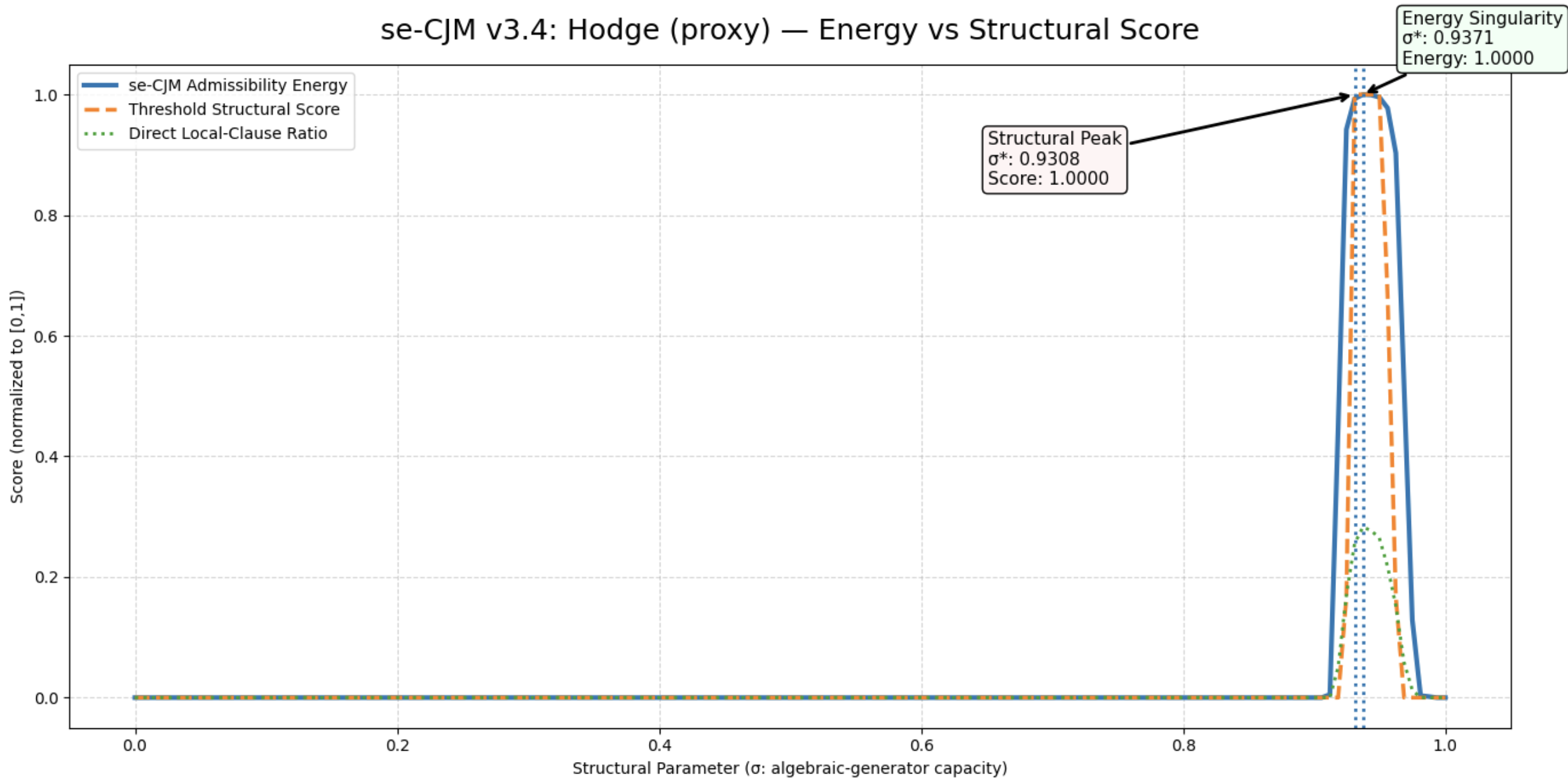 Figure 1: se-CJM v3.4 Hodge proxy with a PySAT-free threshold structural check. The blue curve
shows normalized admissibility energy, the orange dashed curve shows the threshold structural score (\(\theta =0.20\)),
and the green dotted curve shows the direct local-clause ratio. The energy and structural peaks align
in a narrow high-\(\sigma \) region, indicating that the singular zone is both energetically sharp and structurally
coherent under the local 3SAT-like criterion.
Figure 1: se-CJM v3.4 Hodge proxy with a PySAT-free threshold structural check. The blue curve
shows normalized admissibility energy, the orange dashed curve shows the threshold structural score (\(\theta =0.20\)),
and the green dotted curve shows the direct local-clause ratio. The energy and structural peaks align
in a narrow high-\(\sigma \) region, indicating that the singular zone is both energetically sharp and structurally
coherent under the local 3SAT-like criterion.
2.2 Hodge Classes as Resonance Equilibria
To make this admissibility perspective more explicit,
Hodge classes may be interpreted not only as
formal algebraic objects, but also as equilibrium
configurations within a high-dimensional structural
field. Cohomological degrees of freedom encode
continuous variation, whereas algebraic cycles
impose discrete constraints. The relation between
these two levels suggests a resonance-based
interpretation.
Under this view, a Hodge class may be regarded
as a latent mode of structural alignment whose
realizability depends on whether its internal relations
can achieve global coherence. Algebraic realization
then corresponds to the emergence of a stable
equilibrium under admissibility constraints. In
contrast, non-realizable classes remain structurally
misaligned, preventing coherent consolidation into
an algebraically stable form.
This interpretation is consistent with the broader
Changbal perspective, in which realizability is
associated with structural alignment rather than
sequential derivation. The admissible manifold
functions as a selective filter: coherent modes are
preserved, while incompatible configurations are
suppressed. Here, resonance is used as a structural
metaphor for global compatibility, not as a literal
physical claim.
2.3 From Cohomological Structure to Physical
Admissibility
A central step in this framework is the transition
from abstract cohomological structure to physically
interpretable admissibility. Classical approaches
largely remain within symbolic and asymptotic
reasoning. By contrast, the present viewpoint asks
whether structural signatures of cohomological
configurations can be represented in evaluable
spaces governed by coherence and stability
constraints.
To this end, cohomological features are
embedded into constraint-aligned representations in
which admissibility can be examined through
stability metrics, coherence measures, and structural
consistency operators. Such representations are not
intended to preserve the full algebraic richness of the
original objects. Rather, they retain the structural
signatures necessary for discriminating between
admissible and inadmissible configurations.
Once expressed in this form, cohomological
structures become compatible with discrimination
mechanisms operating in the atemporal complexity
class \(O(J)\). Within this setting, the role of CJM is
not to compute algebraic cycles directly, but to
determine whether the embedded configuration
admits a structurally stable equilibrium under global
coherence constraints. This provides the conceptual
bridge to CJM–Hodge and prepares the ground for
the encoding framework developed in the next
section.
3 Mathematical Encoding for CJM–Hodge
This section introduces the mathematical interface
through which the Hodge structure is reinterpreted
within the CJM framework. Rather than operating
directly on symbolic geometric objects, CJM–Hodge
evaluates structural admissibility in an encoded
configuration space. The discussion proceeds in
three steps: geometric-to-structural embedding,
constraint-based admissibility metrics, and
spectral–topological feature construction for stable
discrimination within the atemporal complexity
class O(J) [5].
3.1 Geometric-to-Structural Embedding
The first step in CJM–Hodge is to translate abstract
geometric data into a structurally evaluable
configuration space. Let \((X,\omega )\) be a smooth projective
variety, and let \([\alpha ] \in H^{p,p}(X,\mathbb {Q})\) be a cohomology class of Hodge
type. Classical formulations are expressed in
differential, cohomological, and algebraic terms,
which are not directly suited to structural
admissibility evaluation. We therefore introduce an
embedding
\[ \mathcal {E} : (X,[\alpha ]) \longrightarrow \Sigma , \]
where \(\Sigma \) denotes a constrained structural
representation preserving the invariants relevant to
admissibility.
In this representation, geometric information is
encoded into structural objects such as graphs or
tensorial fields,
\[ G=(V,E,\Psi ), \]
where \(V\) represents local degrees of
freedom, \(E\) represents relational constraints, and \(\Psi \)
represents distributed cohomological signatures. The
purpose of the embedding is not exact algebraic
reconstruction, but the preservation of structural
features relevant to admissibility. In particular, the
representation is designed to preserve topological
continuity, dimensional consistency, and symmetry
relations up to admissible equivalence,
\[ \mathcal {I}(\Sigma )=\{\text {topology},\,\text {dimension},\,\text {symmetry}\}. \]
Accordingly, the encoded representation is treated
as valid when it preserves admissibility-relevant
structure,
\[ \Sigma \mapsto \Sigma ' \qquad \text {such that} \qquad \mathcal {A}(\Sigma )=\mathcal {A}(\Sigma '), \]
where \(\mathcal {A}\) denotes the admissibility
functional. This establishes the interface through
which CJM–Hodge can evaluate cohomological
configurations without requiring full symbolic
reconstruction of the original geometric object.
3.2 Constraint Encoding and Admissibility
Metrics
Once embedded, the structural configuration
is evaluated against a family of admissibility
constraints. Let
\[ \mathcal {C} = \{C_{\mathrm {closure}},\,C_{\mathrm {integrality}},\,C_{\mathrm {symmetry}},\,C_{\mathrm {stability}}\} \]
denote the principal constraint set
governing realizability. These constraints are not
intended as a complete formal characterization
of the Hodge Conjecture; rather, they provide
a structural encoding of the global conditions
that an admissible configuration is expected to
satisfy.
A configuration \(\Sigma \) is treated as admissible when it
satisfies these constraints in the encoded sense. To
measure this, we introduce a composite admissibility
score
\[ E_{\mathrm {adm}}(\Sigma ) = w_1 S_{\mathrm {align}} + w_2 D_{\mathrm {cons}} + w_3 R_{\mathrm {stab}} + w_4 P_{\mathrm {rob}}, \]
where \(S_{\mathrm {align}}\) measures structural alignment, \(D_{\mathrm {cons}}\)
measures constraint consistency, \(R_{\mathrm {stab}}\) measures stability
under resonance-based coherence, and \(P_{\mathrm {rob}}\) measures
perturbation robustness. The encoded objective is
then to identify configurations minimizing the
global admissibility potential,
\[ \Sigma ^\ast = \arg \min _{\Sigma }\,\Phi (\Sigma ), \]
where \(\Phi \) denotes the
structural admissibility potential.
This evaluation is interpreted in the atemporal
complexity class \(O(J)\), where convergence is structural
rather than stepwise. In this setting, CJM–Hodge does
not construct an algebraic cycle directly. Instead, it
evaluates whether the encoded configuration admits
a globally coherent and structurally stable state
under the imposed constraint family.
3.3 Spectral and Topological Feature
Construction
To stabilize admissibility discrimination, the
encoded representation is further enriched by
spectral and topological features. Let \(L\) denote the
structural Laplacian associated with \(\Sigma \). Its spectral
invariants are given by
\[ \mathrm {Spec}(\Sigma )=\{\lambda _i(L)\}_{i=1}^{n}, \]
which capture large-scale
connectivity and coherence structure. Spectral
concentration and entropy provide coarse indicators
of structural regularity,
\[ H_{\mathrm {spec}}(\Sigma ) = -\sum _i p_i \log p_i. \]
Topological features complement this information
by encoding global consistency beyond local
connectivity. Let \(\beta _k(\Sigma )\) denote Betti numbers, and let \(\Pi (\Sigma )\)
denote persistence-based signatures. Structural
admissibility is then associated with bounded
topological fluctuation under admissible perturbation,
\[ \|\Delta \beta _k\| < \varepsilon , \qquad \|\Delta \Pi \| < \varepsilon . \]
The combined feature map
\[ \mathcal {F}(\Sigma ) = \bigl (\mathrm {Spec}(\Sigma ),\,\beta (\Sigma ),\,\Pi (\Sigma )\bigr ) \]
defines the effective
observation space for CJM–Hodge evaluation. In
this representation, realizability is interpreted as the
emergence of a stable attractor-like structure in
feature space rather than as the explicit symbolic
construction of an algebraic representative. This
completes the encoding pipeline from cohomological
structure to discriminable admissibility signals and
prepares the framework for the CJM–Hodge
evaluation developed in the next section.
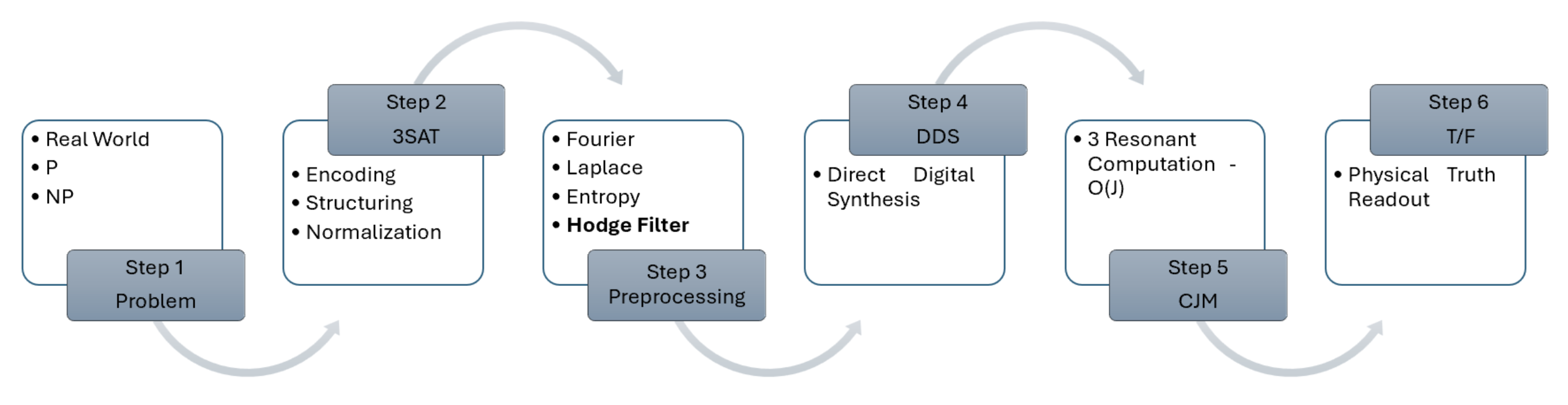
Figure 2: Revised 6-step CJM architecture with the Hodge Filter incorporated into Step 3
(Preprocessing). The filter serves as an admissibility gate between 3SAT structuring and deeper CJM
evaluation. Its operation is defined in Appendix 2 by a six-step conceptual pseudocode: structural
lift, closure screening, coherence screening, stability screening, singularity penalty, and final Hodge
decision. The figure therefore indicates where the Hodge Filter is placed in the pipeline, while the
appendix explains how it works.
4 CJM–Hodge as an Internal Structural
Filter
This section explains how the Hodge admissibility
mechanism is incorporated into the Changbal Jump
Machine (CJM) as an internal structural filter [4].
Under this formulation, the Hodge structure is not
treated as an isolated conjectural target, but as a
specialized admissibility operator within the broader
CJM architecture [1]. Realizability is therefore
interpreted through structural convergence and
admissibility evaluation rather than through explicit
symbolic derivation.
In recursive CJM usage, this role may be
applied not only to abstract Hodge-theoretic
configurations, but also to structurally lifted
SAT-reduced instances. In that setting, CJM–Hodge
functions as a first-pass structural admissibility gate:
it does not decide satisfiability itself, but evaluates
whether the reduced instance possesses sufficient
closure, coherence, and stability to be admitted to
deeper CJM analysis.
Let \(\Sigma \) denote the structural configuration obtained from
the encoding framework introduced in Section 3. In
the Hodge-theoretic setting, \(\Sigma \) represents an encoded
cohomological configuration. In recursive CJM
usage, however, \(\Sigma \) may also represent a structurally
lifted form of a SAT-reduced instance, provided that
the representation preserves admissibility-relevant
invariants. We define the CJM–Hodge filter as an
admissibility operator
\[ \mathcal {H}_{\mathrm {CJM}} : \Sigma \longrightarrow E_{\mathrm {adm}} \in [0,1], \]
where \(E_{\mathrm {adm}}\) represents the degree
of structural admissibility under closure, coherence,
and stability constraints.
In this setting, realizability is not identified
with explicit algebraic construction. Instead, it is
interpreted as the emergence of a structurally
admissible state within the encoded configuration
space. The relevant objective is therefore not
symbolic derivation, but the evaluation of whether a
given configuration approaches a stable minimum of
the admissibility potential,
\[ \Sigma ^\ast = \arg \min _{\Sigma } \Phi (\Sigma ), \]
where \(\Phi \) denotes the
global admissibility potential.
Accordingly, the admissible manifold may be
written schematically as
\[ \mathcal {M}_{\mathrm {adm}} = \{\Sigma \mid \mathcal {H}_{\mathrm {CJM}}(\Sigma )\approx 1\}, \]
indicating the class of
configurations that satisfy the admissibility criteria
in the encoded sense. This formulation does not
claim explicit construction of algebraic cycles,
nor does it treat CJM–Hodge as a satisfiability
solver in its own right. Rather, it provides a
structural criterion for discriminating admissible
from inadmissible configurations prior to deeper
evaluation.
4.2 Filter Integration within CJM
Within the broader CJM architecture, the Hodge
filter is treated as one component of a larger
structural discrimination process. Let
\[ \mathcal {CJM} = \{\mathcal {T},\,\mathcal {E},\,\mathcal {H},\,\mathcal {J}\} \]
denote the
transformation, encoding, Hodge admissibility, and
jump-evaluation stages, respectively. In schematic
form, structural evaluation proceeds through the
composite flow
\[ \Sigma _{t+1} = \mathcal {J}\bigl (\mathcal {H}(\mathcal {E}(\mathcal {T}(\Sigma _t)))\bigr ). \]
This expression is intended to represent
architectural composition rather than a literal
dynamical law. Its role is to show how Hodge
admissibility is integrated into the CJM pipeline:
transformation prepares the configuration,
encoding translates it into an admissibility-relevant
representation, the Hodge filter evaluates structural
permission, and the jump stage determines whether
a stable structural transition is supported in the
atemporal complexity class O(J).
In recursive applications, the same integration
pattern may be applied to SAT-reduced inputs. A
problem instance may first be translated into SAT,
then lifted into an admissibility-relevant structural
representation, after which CJM–Hodge screens the
instance for closure, coherence, and stability before
it proceeds to deeper CJM stages. Under this
interpretation, the Hodge structure becomes a
reusable internal filter rather than a standalone
constructive engine. CJM–Hodge does not explicitly
construct algebraic representatives or directly
decide satisfiability. Instead, it evaluates whether
structurally admissible equilibrium is supported
within the encoded space.
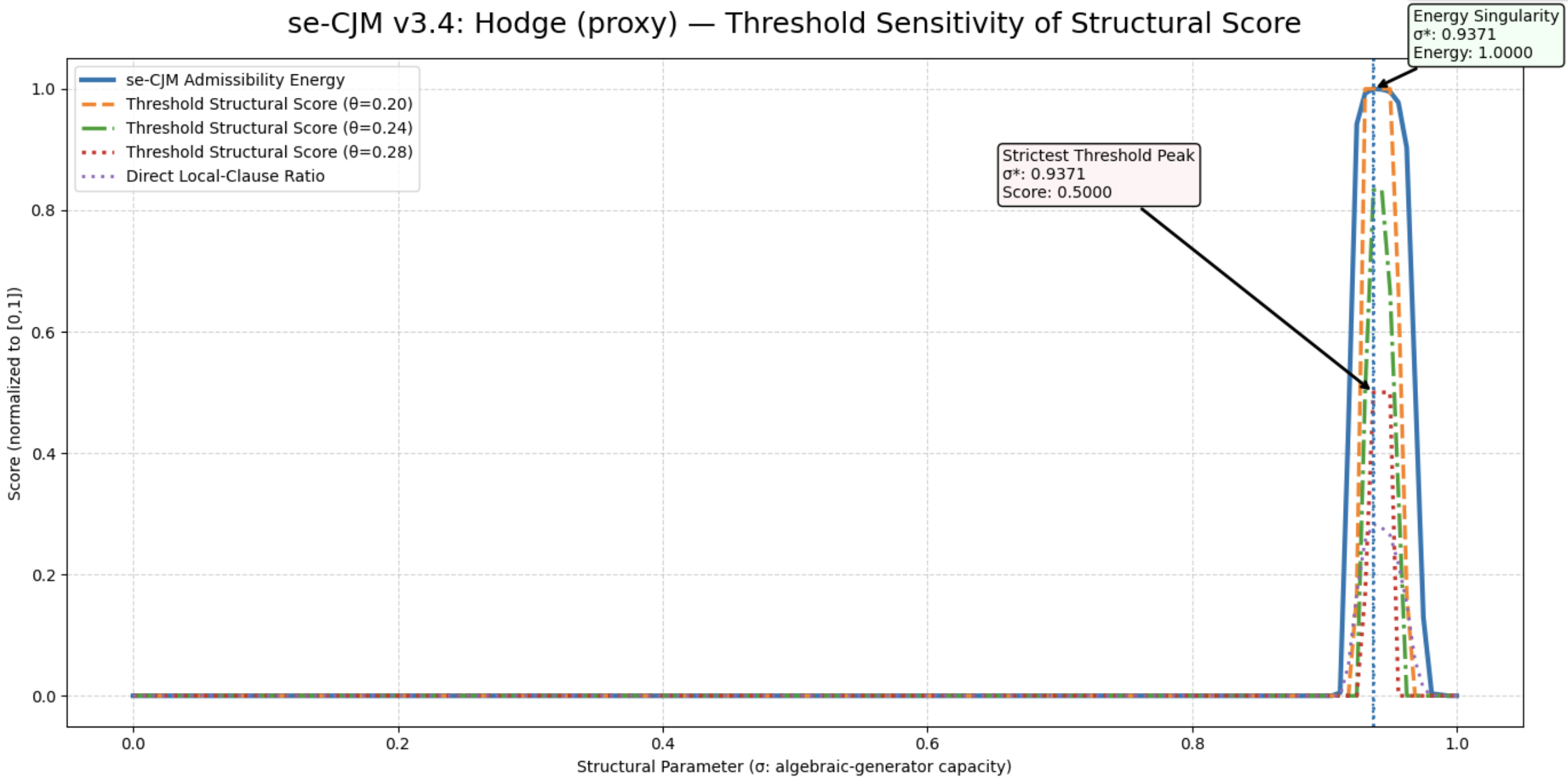
Figure 3: Threshold sensitivity of the se-CJM v3.4 Hodge proxy under a PySAT-free structural check.
The blue curve denotes normalized admissibility energy, the orange/green/red curves denote threshold
structural scores for \(\theta =0.20\), \(0.24\), and \(0.28\), respectively, and the purple dotted curve denotes the direct local-clause
ratio. As the threshold increases, the admissible band contracts stepwise around the same high-\(\sigma \)
singular region rather than shifting to a different location. This indicates that stricter thresholds reduce
the ontological thickness of the admissible region while sharpening its structural core. The strictest
threshold still peaks near \(\sigma ^\ast \approx 0.9371\), showing that the singular zone remains stable even as the admissibility
criterion becomes more selective.
4.3 Structural Convergence and Stability
Manifold
The output of the Hodge filter is interpreted in
terms of structural convergence toward stability.
Let
\[ \mathcal {A} = \{\Sigma ^\ast \mid \Sigma ^\ast \text { is structurally stable under admissibility evaluation}\} \]
denote the set of admissible attractor-like
configurations. Realizability is then associated with
convergence toward this stable set in the encoded
structural space.
A basic stability requirement is that admissibility
should remain robust under small perturbations of
the encoded representation. Schematically, this
may be written as
\[ \|\delta \Sigma \| < \varepsilon \;\Rightarrow \; \|\mathcal {H}_{\mathrm {CJM}}(\Sigma +\delta \Sigma ) - \mathcal {H}_{\mathrm {CJM}}(\Sigma )\| < \eta , \]
indicating that a structurally
admissible configuration should not collapse under
minor variation. In recursive SAT-oriented
usage, such perturbations may be interpreted as
representation-preserving variations that do not
alter the essential structural content of the reduced
instance, but test whether its admissibility is robust
rather than accidental.
In this way, CJM–Hodge is interpreted as a
structural stability filter embedded within the
broader CJM framework. The significance of the
filter lies not in claiming a proof of the Hodge
Conjecture, but in providing an operational notion
of admissibility through which realizability may be
evaluated as stability, coherence, and closure
within the encoded structural domain. In recursive
settings, the same principle allows CJM–Hodge to
serve as a first-stage validator for structurally
lifted SAT instances before further CJM-based
cross-validation.
5 Reusable Structural Filter and Limited
Cross-Domain Extension
Having defined CJM–Hodge as an internal
admissibility operator, we briefly note its possible
role as a reusable structural filter. The emphasis
here is not on domain-specific solution construction,
but on the possibility that the same admissibility
perspective may be adapted to other structurally
constrained systems, including molecular structure
prediction [6] and network instability analysis [7]. In
the present paper, however, the primary focus
remains on the Hodge-theoretic setting.
5.1 Generic Structural Interface
At the schematic level, the CJM–Hodge filter
exposes an admissibility interface of the form
\[ \mathcal {H}_{\mathrm {CJM}} : \Sigma \rightarrow E_{\mathrm {adm}}, \]
where
\(\Sigma \) denotes an encoded structural configuration and \(E_{\mathrm {adm}}\)
denotes its admissibility score. In principle, any
system admitting a structurally meaningful encoding
may be examined through a similar interface. This
does not imply domain-independence in any strict
formal sense, but suggests that the admissibility
viewpoint may be transferable beyond the present
setting.
5.2 Restricted Cross-Domain Interpretation
Because the present formulation emphasizes structural
coherence rather than symbolic derivation, analogous
interpretations may be conceivable in other
constrained systems. For example, admissibility may
correspond to stable conformations in molecular
settings, stable trajectories in dynamical systems,
or coherent organizational states in networked
structures. These parallels are intended only as
interpretive extensions. They are not developed
here as formal applications, and they do not
alter the Hodge-centered scope of the present
paper.
5.3 Implementation Note
A procedural description of the CJM–Hodge filter is
deferred to Appendix 2, where it is presented as
conceptual pseudocode rather than executable
software. The appendix summarizes the filter as a
six-stage admissibility procedure: structural lift,
closure screening, coherence screening, stability
screening, singularity penalty, and final Hodge
decision.
This keeps the main text focused on the
architectural and interpretive role of CJM–Hodge,
while deferring broader implementation details to
the appendix.
In this limited sense, CJM–Hodge may be viewed
not only as a Hodge-oriented admissibility operator,
but also as a candidate template for structurally
constrained evaluation in other settings.
6 Conclusion
6.1 From Constructive Proof to Structural
Admissibility
This paper has reinterpreted the Hodge Conjecture
not primarily as a problem of symbolic construction,
but as a problem of structural admissibility within
the Changbal Jump Machine (CJM) framework.
Instead of focusing on the derivation of algebraic
representatives, the discussion has emphasized closure,
coherence, and stability as the conditions governing
realizability [8]. In this sense, transformation
precedes computation, and admissibility becomes
the criterion through which realizability is
examined.
By encoding cohomological structure into a
CJM-compatible representation, realizability is
treated as a question of structural permission within
an admissible configuration space. Under this
viewpoint, admissible configurations correspond to
structurally stable states, whereas inadmissible ones
fail to maintain global coherence. No formal proof
of the Hodge Conjecture is claimed. Rather,
the contribution of this work is to propose a
structural lens through which the problem may
be reinterpreted without displacing its classical
mathematical form.
6.2 CJM–Hodge as an Internal Admissibility
Filter
A central proposal of this work is the introduction of
CJM–Hodge as an internal admissibility filter
within the broader CJM architecture. Under this
interpretation, the Hodge structure is treated not as
an isolated target of direct construction, but as a
structural operator for evaluating whether a
given encoded configuration supports admissible
realization under global constraints.
In this role, CJM–Hodge does not explicitly
construct algebraic cycles. Its function is instead
to discriminate, in the encoded sense, between
configurations that are structurally stable and
those that are not. This provides an operational
interpretation of realizability while keeping
the conjecture itself open and mathematically
unresolved.
6.3 Conceptual Scope and Final Perspective
The main significance of this framework lies in its
conceptual reformulation of realizability. The
present work suggests that, at least at the level of
interpretation, realizability may be examined
through admissibility, stability, and coherence rather
than through sequential construction alone [9].
This shift does not replace classical proof-based
mathematics, but offers a complementary perspective
for understanding why certain structures may or
may not admit realization.
Accordingly, the contribution of this paper is
foundational rather than definitive. It establishes the
conceptual basis of CJM–Hodge as a structural
admissibility framework for the Hodge-theoretic
setting, while leaving broader implementations and
extensions to future work. In this limited but
deliberate sense, the paper closes not with a proof,
but with a reformulated question: whether algebraic
realizability may be more clearly understood when
viewed through the lens of structural admissibility.
Open Question.
Does a problem \(\Phi \) admit a solution if and only if
it is structurally admissible under atemporal
resonance?
References
-
[1]
- Yoon, K. (2025). \(P \equiv NP^{J}\): On the End of Time.
-
[2]
- Voisin, C. (2002). A Counterexample to the
Hodge Conjecture Extended to
Kähler Varieties. International Mathematics
Research Notices, 2002(20), 1057–1075.
-
[3]
- Thomas, R. P. (2005). Nodes and the Hodge
Conjecture. Journal of Algebraic Geometry,
14(1), 177–185.
-
[4]
- Simpson, C. (2008). Algebraic Cycles from
a Computational Point of View. Theoretical
Computer Science, 392(1–3), 128–140.
-
[5]
- Chen, J., Wei, Z., Xia, K., & Wei, G.-W.
(2021). Evolutionary de Rham-Hodge Method.
Discrete and Continuous Dynamical Systems
- Series B, 26(7), 3785–3821.
-
[6]
- Galanakis, N., Koutsoukas, A., Fenton, R. R.,
& Wales, D. J.
(2024). Rapid Prediction of Molecular Crystal
Structures Using a Topological Approach.
Nature Communications, 15, 9357.
-
[7]
- Duan, C., Garlaschelli, D., & Squartini,
T. (2022). Network Structural Origin of
Instabilities in Large Complex Systems.
Science Advances, 8(46), eabm8310.
-
[8]
- Totaro, B. (2013). On the Integral Hodge and
Tate Conjectures over a Number Field. Forum
of Mathematics, Sigma, 1, e4.
-
[9]
- Klingler, B., Otwinowska, A., & Urbanski, D.
(2021). On the Closure of the Hodge Locus
of Positive Period Dimension. Inventiones
Mathematicae, 225, 857–883.
rng = np.random.default_rng(seed)
    S, T = np.meshgrid(sigma_range, t_vals)  # rows=t, cols=sigma
    # Deterministic structure component: ramp + oscillation
    ramp = (S ** 2.2)
    osc = osc_amp * np.sin(2 * np.pi * T / osc_period) * (S ** 1.8)
    # "closure pressure" with mild noise
    base = ramp + osc + noise * rng.standard_normal(size=ramp.shape)
    # A "critical region" bias near high sigma to create a sharp structural zone
    critical = np.exp(-((S - 0.93) ** 2) / (2 * (0.04 ** 2)))
    score = base + 0.35 * critical
    # Nonlinear gate -> literals
    g = 1 / (1 + np.exp(-alpha * (score - np.median(score))))
    # x1: strongest events
    thr1 = np.quantile(g, 0.995)
    x1 = (g >= thr1).astype(np.uint8)
    # x2: sharpened companion
    g2 = g ** q
    thr2 = np.quantile(g2, 0.990)
    x2 = (g2 >= thr2).astype(np.uint8)
# Full code available at the links below (Colab, GitHub, project website).
Appendix 2: Hodge Filter
Pseudocode
PROCEDURE step1_input_hodge_filter(input_instance):

    # Interpret input according to its current form
    IF input_instance is RealWorldProblem Phi:
        F <- ReduceToSAT(Phi)
        Sigma <- LiftToStructuralRepresentation(F)

    ELSE IF input_instance is SATReducedInstance F:
        Sigma <- LiftToStructuralRepresentation(F)
    ELSE:
        Sigma <- input_instance
    # Preserve only admissibility-relevant invariants
    Preserve:
        - topology
        - dimensional consistency
        - relational symmetry
        - clause/variable coupling structure
    RETURN Sigma
# Full code available at the links below (Colab, GitHub, project website).
structural_score = np.zeros(Sn, dtype=np.float64)
direct_rate = np.zeros(Sn, dtype=np.float64)
for j in range(Sn):
    x1_col = x1[:, j]
    x2_col = x2[:, j]
    pass_count = 0
    tested = 0
    direct_scores = []
    for start in starts:
        truths = build_local_clause_truths_for_
        sigma_window(
            x1_col, x2_col, gate=gate, start=start, win=win
        )
        if len(truths) == 0:
            local_truth_ratio = 1.0
        else:
           local_truth_ratio = float(np.mean(truths))
        direct_scores.append(local_truth_ratio)
        tested += 1

        if local_truth_ratio >= theta:
            pass_count += 1
    structural_score[j] = pass_count / max(1, tested)
    direct_rate[j] = float(np.mean(direct_scores)) if direct_scores else 1.0
return np.clip(structural_score, 0.0, 1.0), np.clip(direct_rate, 0.0, 1.0)

# Full code available at the links below (Colab, GitHub, project website).